
Menu
Choosing the Right Concrete for Paths & Walkways in Stamford
Concrete Walkway Stamford
Selecting appropriate concrete for walkways and paths in Stamford requires understanding Connecticut building codes, environmental conditions, and design requirements. From residential sidewalks in Bulls Head to commercial walkways near Hubbard Heights, proper concrete walkway selection ensures durability, safety, and aesthetic appeal while meeting all local requirements and withstanding Connecticut’s challenging climate.
Standard Concrete Walkway Specifications
Thickness Requirements
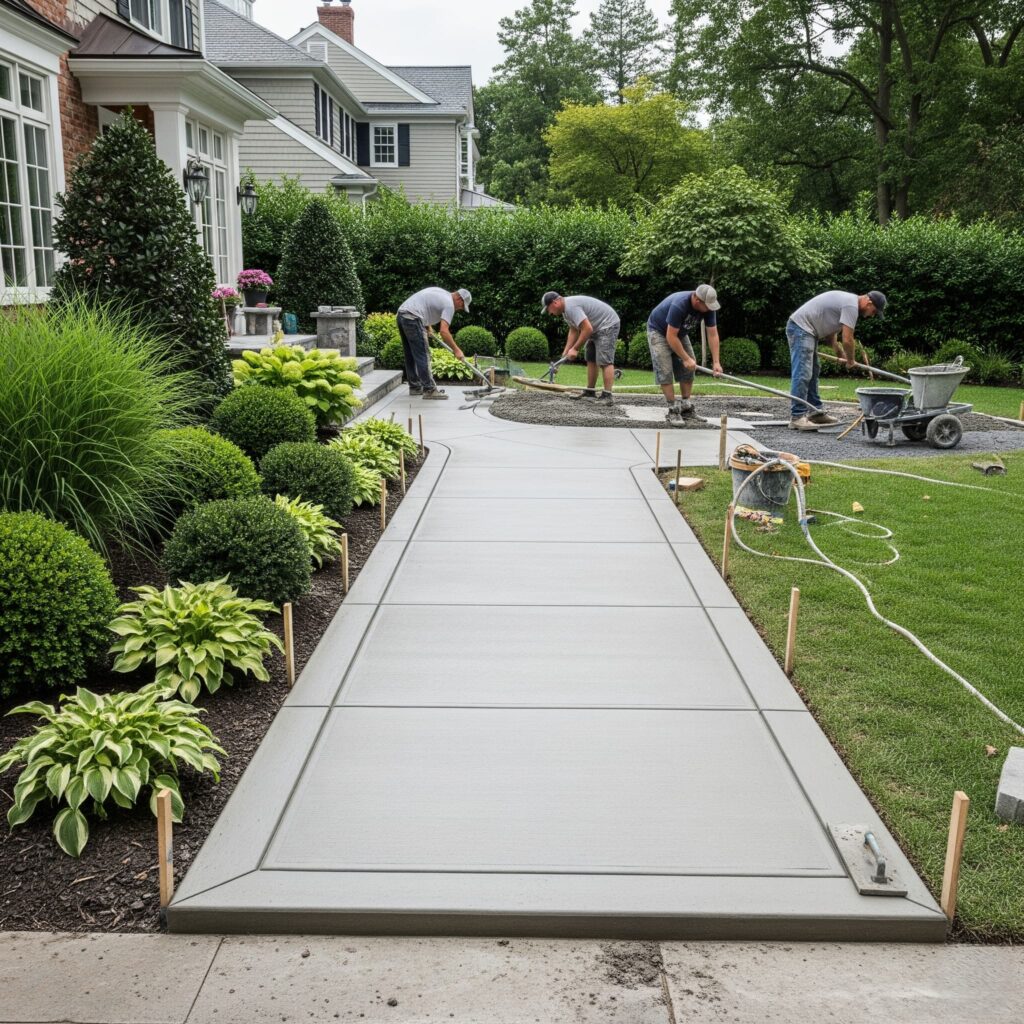
Most residential walkways have a standard thickness of 4 inches. The 4-inch thickness will allow for some cracking and will last many years if the walkway is properly maintained. Most residential and commercial walkways have a 4-inch thickness.
Typically, a contractor will pour a 4-inch-thick concrete walkway. Pouring a 4-inch thick walkway is more cost-effective than a 6 or 8-inch thick walkway and has enough durability for normal usage. If your walkway is used for foot traffic, hand trucks, and bicycles only, you will likely enjoy a long-lived surface.
Enhanced Walkway Thickness
If you have a large amount of foot traffic, then your walkway will need to be 5 to 6 inches thick. A walkway that is used by motorized service vehicles or crosses a driveway will need to be at least 8 inches thick to withstand the additional weight without cracking or settling.
Commercial walkways and paths, which are occasionally traveled upon by vehicles, will need to have reinforced structures to provide structural integrity and durability. Properties located in Stamford’s business districts usually call for a walkway thickness of 5 to 6 inches to ensure a combination of pedestrian and light vehicle travel.
Climate Conditions in Connecticut
Resistance to Freeze-Thaw Cycle
Winter weather conditions in Connecticut necessitate that walkways be made of concrete, which has been specially formulated to withstand the freezing and thawing cycles. Air-entraining concrete is designed to help the ice form within the concrete expand without causing cracking or spalling.
Salt-air exposure and varying amounts of moisture found in Stamford’s coastal environment present additional challenges. Air entrainment and proper water-to-cement ratio must be incorporated into the concrete mix to ensure long-term performance in this harsh environment.
Weather Conditions for Installing Walkways
The weather in Connecticut affects both the time of year to install concrete walkways and the curing of the walkways. Spring to Fall is the best season for installing concrete walkways, and the best time for doing so is generally after a rain. Winter pours will need to be done in a manner that allows for proper curing and strength development.
Experienced concrete contractors know the effects of seasonal variations and make adjustments to their installation procedures accordingly to ensure the best possible outcome.
Criteria for Selecting Walkway Materials
Requirements for Concrete Strength
A standard residential walkway should have a concrete strength rating of 3,000 to 4,000 pounds per square inch (PSI). The strength of the concrete will provide sufficient bearing capacity for pedestrians and also provide the durability needed to withstand the environmental conditions in Connecticut.
Choose a quality concrete mix that has the correct type of cement, aggregate, and water to produce a well-mixed concrete that resists cracking and will last for decades with proper maintenance and application of periodic sealer coatings.
Selection of Aggregates
Both the performance and aesthetic appeal of concrete walkways are dependent on the type of aggregate selected. Basic walkways can be built with standard aggregates and be economically viable. Decorative aggregates can be used to build attractive walkways that display a variety of different exposed aggregate finishes.
Using local aggregates to build your walkway is beneficial because it reduces transportation costs, and the aggregates are better suited to the climatic conditions in Connecticut. Quality aggregates provide the structural matrix necessary to provide long-term durability to your walkway.
Design and Planning Considerations
Requirements for Accessibility Under ADA Guidelines
When designing modern walkways, the designer must take into account the accessibility requirements for both public and commercial walkways. ADA-compliant walkways cannot have slopes greater than 1:20 or 5%, and the cross slope cannot exceed 1:48 to allow for wheelchair accessibility.
Walkways must be constructed of hard materials, such as concrete, asphalt, and wood, and must have a minimum width of 36 inches for general pedestrian traffic. Many commercial properties have wider walkways to accommodate higher pedestrian volume.
Placement of Control Joints
Controlling the cracking of walkways is accomplished by the proper placement of control joints. Control joints are created by placing preformed foam or rubber strips between the slabs prior to the completion of the concrete pour, which allows the walkway to expand and contract with temperature fluctuations without cracking.
The placement of control joints should be approximately 4 to 6 feet apart for 4-inch-thick walkways. The depth of each control joint should extend to one-fourth the depth of the walkway. Maintaining the joints by sealing them prevents water from entering the joint and maintains the structural integrity of the walkway.
Options for Reinforcing Walkways
Wire Mesh vs. Rebar
Wire mesh is a thin yet strong layer that is embedded in the concrete walkways, arranged in a grid pattern, that provides multiple reinforcement points for pedestrian traffic. Wire mesh is relatively inexpensive and has a cost range of $50 to $200, depending on the size of the project. It provides the necessary strength for most pedestrian applications.
Rebar is a thicker and stronger reinforcement option for heavy-duty applications. Use rebar or wire mesh in areas of the walkway that are expected to experience heavy foot traffic or difficult environmental conditions. Rebar will assist in distributing the loads and preventing cracking in the walkway.
Steel or Synthetic Fiber Reinforcement
Fiber reinforcement adds to the ability of concrete to resist cracking by adding fibers to the concrete matrix. Fiber reinforcement is beneficial for walkways that will be subjected to thermal stress or ground movement that is typical in Connecticut’s varied soil conditions.
Fiber reinforcement is a supplemental method of reinforcement and provides additional assurance against developing cracks in the walkway while maintaining workability during installation.
Finishing Options for Walkway Surfaces
Common Finishing Methods
Broom finishing is the most common walkway finishing method, and provides good traction and weather resistance at an affordable price. Broom finishing produces a textured surface that provides good slip resistance while being easy to maintain.
Trowel-finished walkways provide a smooth surface that is suitable for covered walkways or areas where cleaning is easier than maximizing slip resistance. When troweling a walkway, proper technique will result in a consistent finish and optimal performance.
Decorative Finish Options
Stamped walkways are attractive and durable alternatives to natural stone, brick, or tile. Stamping the concrete creates patterns that simulate the look of various natural materials, while still providing the durability and low-maintenance qualities of concrete.
Stamping works very well for residential applications in neighborhoods like Revonah Woods, where aesthetic appeal enhances property values.
Exposed Aggregate Finish Options
Exposed aggregate finishes display decorative stone that is embedded in the concrete matrix, producing attractive and slip-resistant surfaces that are suitable for both residential and commercial walkway applications in Stamford.
Best Practices for Installing Walkways
Requirements for Site Preparation
Properly preparing the sub-grade for a walkway is essential for long-term performance. All unsuitable materials such as topsoil, vegetation, etc., must be removed. Then the sub-grade must be compacted until it is stable. The sub-grade must be constructed to bein linee and level.
Installing a base course of clean, graded sand, gravel, or crushed stone will provide drainage and even support for the walkway. Proper sub-grade preparation eliminates the potential for future settlement and cracking in the walkway.
Best Practices for Forming and Placing Walkways
Accurate forming of a walkway will produce accurate dimensions and smooth edges. The forms must be sturdy enough to hold their shape during the concrete pour and finishing process, and provide smooth, straight edges for a professional-looking finish.
Placing the concrete and vibrating the concrete to remove air voids, especially near the edges and reinforcement, will result in a uniformly dense surface and optimal finish.
Planning for the Future Maintenance of Your Walkway
Protective Coatings
Applying a protective coating to a concrete walkway will protect it from water infiltration, freeze-thaw damage, and stains from organic matter or de-icer chemicals. Protective coatings will extend the life of the walkway while maintaining its appearance and slip resistance.
Application of protective coatings to walkways depends on the level of traffic they receive and their exposure to environmental factors. Typically, protective coatings will need to be reapplied every two to three years to continue protecting the walkway in Connecticut’s climate.
Maintenance Programs for Walkways
Cleaning of walkways regularly will help remove debris that can stain the surface and/or cause premature deterioration. Repairing cracks promptly will help prevent water from entering the crack and potentially leading to freeze-thaw damage and continued deterioration.
Professional maintenance programs include regularly inspecting the walkway, repairing cracks, sealing joints, and applying protective coatings to maximize the lifespan of the walkway and maintain a safe walking surface.
Factors Affecting Cost
Cost of Materials and Labor
The average cost of a concrete walkway is approximately $2,000 for a 200 square foot area, or approximately $10 per square foot, including materials and labor. The cost for materials and labor will cover a standard 44-inch-thickwalkway with a basic broom finish that will satisfy most residential walkway applications.
Various finishes, increased thicknesses, and decorative elements can add expense to a walkway but will provide additional value to the walkway through improved appearance and function. Professional installation will provide the best possible results and will include any required permits and inspections.
Assessment of Long-Term Value
High-quality walkways will provide excellent long-term value to homeowners through minimal maintenance requirements and decades of dependable service. High-quality materials and professional installation of the walkway will create a walkway that increases the value of the home while providing a safe and visually appealing means of pedestrian access throughout Stamford’s diverse neighborhoods.
Investment in Quality Walkway Construction Will Pay Dividends
The investment in constructing a quality walkway will pay dividends through lower maintenance costs, enhanced curb appeal, and improved property functionality throughout Stamford’s established neighborhoods.
Local Code Compliance
Stamford City Building Requirements
There are minimum requirements for walkway construction specified in the local building code, including thickness, reinforcement, and accessibility compliance. Experienced contractors are familiar with local regulations and will ensure all work meets or exceeds local building code requirements.
Permits Required for Walkways
The types of permits that are required to construct a walkway will depend on the location and scope of the walkway. Public walkways will typically require more strict compliance than private residential walkways. Experienced contractors will assist in obtaining the necessary permits and scheduling the required inspections.
Coordination of Utilities
Walkway construction often involves coordinating with other utilities, including water, sewer, electric, and telecommunications, that are located beneath the walkway. Experienced contractors will locate and protect the utilities during the construction of the walkway to prevent damage to the utilities and disruption of service.
Proper coordination of utilities will prevent costly delays and will ensure that the walkway is constructed in a manner that is compatible with existing infrastructure throughout Stamford’s developed neighborhoods.
Environmental Factors
Drainage for Walkways
Drainage for walkways must be properly integrated to prevent standing water that can cause ice to form, damage to the walkway, and safety hazards to pedestrians. The walkway design will incorporate proper slopes and drainage connections to manage stormwater runoff.
Compliance with Environmental Regulations
Compliance with environmental regulations includes managing stormwater runoff to prevent erosion and degradation of water quality. The walkway design will integrate with existing stormwater management systems to comply with environmental regulations.
Use of Sustainable Materials
Sustainable concrete products include recycled aggregates, supplementary cementitious materials, and locally sourced materials that reduce environmental impacts while maintaining performance characteristics. The walkway design will consider the lifecycle impacts, including the source of materials, energy consumed during installation, and long-term maintenance needs, to minimize the total environmental footprint of the walkway.
At Stamford Concrete Pros, we specialize in designing and installing concrete walkways that meet the unique demands of Connecticut while enhancing the aesthetic and functional aspects of your property. Our staff has extensive knowledge of local building codes, ADA-compliance specifications, and the distinct environmental challenges of Stamford’s coastal region. We provide complete services for walkway projects, including selecting materials, installing the walkway, and establishing a maintenance plan for the walkway. Whether you require standard walkways or decorative walkway features, our commitment to excellence will deliver results that will enhance the functionality, accessibility, and curb appeal of your property. Contact us today to discuss your walkway project and discover how utilizing the best available materials and expert installation will provide a long-lived walkway that will serve you and your family for generations.
LATEST POSTS