Menu
Choosing the Right Concrete Slab Thickness for Stamford Homes
Concrete Slab Stamford
Selecting an appropriate concrete slab thickness for Stamford residential projects requires understanding Connecticut building codes, local soil conditions, and intended use requirements. From basement floors in homes near Oak Hills Park to garage slabs in properties around Stamford Town Center, proper thickness selection ensures structural integrity and long-term performance in Connecticut’s challenging climate.
Connecticut Building Code Requirements
Minimum Thickness Standards
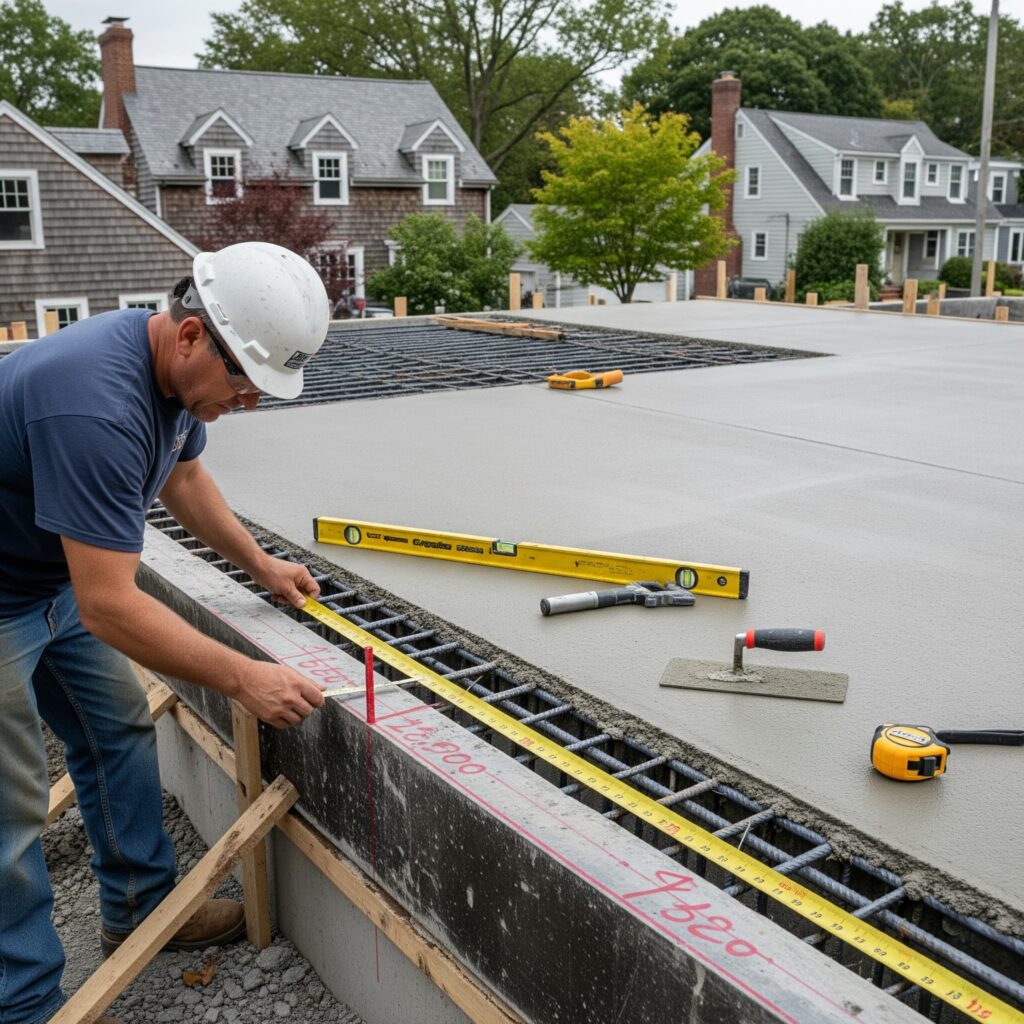
Connecticut’s building code sets forth the minimum thickness for concrete slabs for residential construction. Floors must be no less than 3½ inches (89 mm) thick, as stated in the 2022 Connecticut State Building Code. A concrete floor slab that supports only the ground must be no less than 3½ inches (89 mm) thick. Most residential applications utilize this as a minimum standard.
Ensuring that a concrete slab can handle normal loads and environmental stressors, and prevent cracking, settling, and structural problems associated with the freeze-thaw cycle, is the purpose of setting forth the minimum thickness requirements for concrete slabs. Ensuring compliance with these standards is a necessity for all residential construction in Stamford.
Vapor Barrier Requirements
There are minimum requirements for moisture protection for concrete slabs in Connecticut building codes. All concrete floor slabs must have a 10-mil (0.010 inch, 0.254 mm) vapor retarder. The vapor retarder must meet the requirements of ASTM E1745 Class A. Joints must overlap by at least six inches (152 mm). The vapor retarder must be located between the concrete floor slab and the base course or the prepared subgrade.
All residential applications are included in this requirement, except for garages, utility buildings, and other unheated accessory structures. Also, unheated storage rooms less than 70 sq ft are excluded. Unheated storage rooms larger than 70 sq ft and unheated storage sheds are included. Driveways, walkways, patios, and other flatwork not enclosed and heated are also excluded.
Thickness Requirements for Specific Applications
Thickness Requirements for Basement and Interior Floor Slabs
Typically, basement floors in Stamford residences require a minimum thickness of 4 inches. This provides both structural support and moisture protection. The thickness of a concrete floor varies greatly depending on its intended function. Typical residential uses include 3.5 to 4 inches for basic interior functions.
Homes may be situated in areas with difficult soil conditions or high water tables. Examples include homes along the coast and Landmark Square. In these cases, additional thickness may be required to protect against moisture and provide adequate structural support. Based on the specific site conditions, the thickness is determined by a professional.
Thickness Requirements for Garage Floors
To support automobile loads and to resist the effects of automobile fluids, garage floors require greater thickness than residential floors. Typically, a 4-inch minimum thickness is adequate for most residential garages. However, for garages with heavy loads, a 5 to 6-inch thickness is recommended.
Some Stamford residents may anticipate heavy loads, such as delivery trucks or RVs. For these applications, a 6-inch thickness is recommended. The best thickness for a garage floor is 6 inches. This provides the structural strength to handle concentrated loads without cracking or settling.
Thickness Requirements for Driveways and Exterior Slabs
Typically, residential driveways in Stamford require 4 to 6 inches of thickness. The amount of thickness depends on the anticipated vehicle loads. A thickness of 4 to 6 inches is recommended for residential driveways that accommodate the typical passenger vehicle. This provides enough structural strength and durability to withstand the weight of automobiles and minimize the potential for cracking or settling.
If a driveway will be subjected to heavier-than-average loads, a thicker slab may be necessary. For example, if a driveway anticipates occasional use by garbage trucks, RVs, etc., a thickness of 6 inches or greater may be necessary to distribute the weight appropriately and provide long-lasting performance.
Structural Load-Bearing Considerations
Calculating Weight Loads
In addition to providing structural support, the thickness of a concrete slab affects its ability to bear loads and perform structurally. A 6-inch thick slab of 4,000 psi concrete can support specific loads when properly prepared and cured. Specifically, a well-prepared and properly cured 6-inch thick slab of 4,000 psi concrete can support a concentrated load of 3,000 pounds applied over a 1-square-foot area. Thus, it is capable of supporting vehicles in residential garages.
Increases in thickness also provide proportional increases in structural performance. For example, an increase in thickness from 4 to 5 inches can potentially increase a slab’s load-bearing capacity by approximately 50%. However, this will also increase the cost of the slab by approximately 20%.
Reinforcing Requirements
Typically, Connecticut building codes require reinforcement for concrete slabs that exceed specific thickness requirements. Additionally, reinforcing may be required for concrete slabs that will support specific loads. In general, when a slab is poured at a thickness of 5 inches or greater, it will typically be required to be reinforced with steel rebar. This will increase the cost of the slab; however, it will also provide the structural integrity that will be required.
For the most part, all concrete slabs that are poured at a thickness of 4 inches or greater will need some form of steel reinforcement. Steel reinforcement will provide additional structural capability to the slab, and will provide additional structural capabilities, especially if the slab is subjected to heavy loads. Typically, wire mesh is used to reinforce slabs that are poured at a thickness of 4 to 5 inches, and rebar is used for slabs that are 5 inches or thicker.
Factors That Are Specific to Connecticut’s Environment
Environmental Challenges Associated with Freeze-Thaw Cycles
Connecticut’s climate presents challenges to designing and specifying the thickness of concrete slabs. One of the major challenges is the frequency of freeze-thaw cycles in Connecticut. Increasing the thickness of the slab will assist in resisting cracking due to frost heave and thermal expansion. Proper thickness selection and air-entrained concrete will provide maximum freeze-thaw resistance.
Additionally, climate and weather conditions affect the optimal thickness of concrete slabs. Thicker slabs provide improved resistance to cracking and damage in regions with extreme weather patterns.
Environmental Challenges – Moisture Management and Drainage
The coastal nature of Stamford and the variability in precipitation necessitate attention to moisture management in concrete slab design. Proper thickness selection, combined with adequate drainage, will provide a protective barrier against water damage. Proper thickness selection, combined with adequate drainage, will provide the longest possible life for the concrete slab in Connecticut’s humid climate.
Vegetation, topsoil, and foreign material shall be removed from the area inside the foundation walls. Clean, dry fill material shall be used that contains no vegetation or foreign material. The fill shall be compacted to provide a uniform support system for the slab. The maximum allowable fill height shall be 24 inches for clean sand or gravel and 8 inches for earth.
Geotechnical Factors – Stamford Soils
Characteristics of Stamford Soils
Due to the diversity of geology in Stamford, various soil types exist, which impact the required thickness of the concrete slab. Properties located in coastal areas may require a completely different approach to their soil conditions, as opposed to properties located in the inland clay deposits or rocky terrains found in the hillier areas of Stamford.
If the soil beneath the concrete slab is unstable or has a low load-bearing capacity, the thickness of the concrete slab may need to be increased to provide additional support. A qualified geotechnical engineer or civil engineer will assess the soil conditions and make recommendations for adjusting the thickness of the concrete slab as required.
Base Course Requirements
Preparation of Base Courses
Adequate preparation of the base course will ensure the optimal performance of the concrete slab regardless of the thickness selected. A base course 4 inches thick of approved materials shall be utilized. Materials approved for use in a base course include clean graded sand, gravel, crushed stone, crushed concrete, or crushed blast furnace slag that passes a 2-inch sieve. The base course shall be laid upon the prepared subgrade where the slab is below grade.
Exceptions to the Base Course Requirement
Exception for Well-Distributed Soils
A base course is not required when a concrete slab is installed on well-distributed soils. Well-distributed soils are defined as those soils classified as Group I according to the United Soil Classification System. Examples of well-distributed soils include a sand-gravel mixture. This exception may be applicable to specific areas of Stamford where the soil conditions are favorable.
Economic Considerations
Cost vs. Performance Analysis
The thickness of a concrete slab has a significant impact on the overall cost of a project. Therefore, a careful balance must be maintained between the desired performance and budgetary limitations. Although thicker slabs provide increased durability, there is an increased cost associated with thicker slabs, resulting from the increased quantity of materials and labor required to pour a thicker slab.
However, the extra inch of depth can also represent an approximate 20% increase in your total concrete cost. As such, a cost-benefit analysis is essential in determining the optimal thickness for your project. Although the increased upfront costs of a thicker slab may outweigh the benefits, investing in a thicker slab may be an advantageous decision. It provides a stronger slab that will perform longer and endure the wear and tear of heavy loads.
Assessing Long-Term Economic Benefits
Optimal thickness selection of a concrete slab will provide long-term economic benefits through the reduction of maintenance requirements and extension of service life. You will obtain a stronger slab that will last longer and endure heavy loads better. The need for repairs and/or replacement will decrease over the life of the slab.
The combination of optimal thickness selection and quality installation will provide the best return on investment for Stamford residents. This is especially true in light of Stamford’s competitive real estate market and high property values.
Design and Material Requirements for Concrete Slabs
Requirements for Compressive Strength
Connecticut building codes set forth minimum compressive strength requirements for concrete slabs. Concrete shall have a minimum specified compressive strength of f’c, as shown in Table R402.2. Typically, residential applications require 3,000 to 4,000 psi concrete for optimal performance.
The concrete selected must have sufficient compressive strength to support the weight of vehicles and prevent cracking. A minimum compressive strength of 3,000 to 4,000 psi is commonly recommended for residential applications. This will ensure satisfactory performance in Connecticut’s challenging environment.
Requirements for Air Entrainment
Air-entrained concrete is required for exterior applications in Connecticut’s freeze-thaw climate. Air-entrained concrete shall be used for concrete that will be exposed to moderate or severe weathering, as indicated in Table R301.2, as specified in Table R402.2. The air entrainment will provide space for expanding ice in the concrete.
Adding air-entraining agents to the concrete mix will enhance the concrete’s resistance to freeze-thaw cycles. This is critical for long-term performance in Stamford’s variable climate conditions. The air-entraining agents will produce small, evenly dispersed air bubbles in the concrete, allowing water to expand and contract without damaging the concrete.
Special Requirements for Edge Thickening and Other Special Details
Reinforcing Perimeters of Concrete Slabs
It is generally recommended by professional contractors to increase the thickness of the edges of a concrete slab to provide additional structural support. Your concrete contractor may recommend increasing the thickness at the edges of your concrete by one to two inches. This will provide additional structural support, especially beneficial to driveways and exterior slabs.
The edges of a concrete slab are the portions of the slab that are most susceptible to heavy loads and have the least amount of soil support compared to the center of the slab. Therefore, they are the most susceptible to settlement and cracking. To receive the greatest advantage, the thickened edge sections should be extended four to eight inches into the perimeter.
Transition Areas
Special consideration must be made for areas where a concrete slab abuts another structural element. Transition zones may require specialized thickness requirements. Many municipalities require the concrete apron at the entrance of driveways to be constructed at a five- or six-inch thickness. This will augment the load-carrying capacity of the concrete apron and facilitate smooth transitions to public roadways.
Professional design will address these transition zones to ensure proper load transfer. The design will also provide for equal settlement of the slab and surrounding structural elements to prevent the potential for differential settlement and eventual damage to the slab.
Best Practices for Installing and Controlling the Quality of Concrete Slabs
Professional Evaluation of Optimal Thickness Selection
Optimizing the thickness of a concrete slab is dependent upon several factors, including site conditions, intended use, local building codes, and climatic conditions. A professional contractor will evaluate the site conditions, intended use, local building codes, and climatic conditions to provide the homeowner with recommendations for the optimal thickness for their specific concrete slab project.
Qualified contractors are knowledgeable about Connecticut building codes, local soil conditions, and the installation requirements necessary for successful performance of the concrete slab. The professional evaluation will ensure that the selected thickness will provide satisfactory performance for the homeowner’s specific project.
Principles of Good Installation Practices
Good installation practices will maximize the benefits provided by selecting the correct thickness for the homeowner’s specific project. Good quality control during placement, finishing, and curing will assure that the selected thickness provides the intended performance characteristics throughout the entire service life of the slab.
Good installation practices include good subgrade preparation, accurate thickness control, proper placement of reinforcement, and proper finishing techniques. These good installation practices will optimize the performance of the concrete slab in Connecticut’s challenging environment.
At Stamford Concrete Pros, we provide comprehensive concrete slab design and installation services. We tailor our services to Connecticut building codes and local conditions. Our experienced staff evaluates the soil conditions, load requirements, and environmental conditions to determine the optimal thickness for each application. Whether you require basement floors, garage slabs, or driveway construction, we will provide you with the optimal thickness and professional installation. Our work consistently meets or exceeds the requirements of Connecticut building codes. Please contact us today to discuss your concrete slab project. Take advantage of our extensive local experience and commitment to quality construction practices.
LATEST POSTS